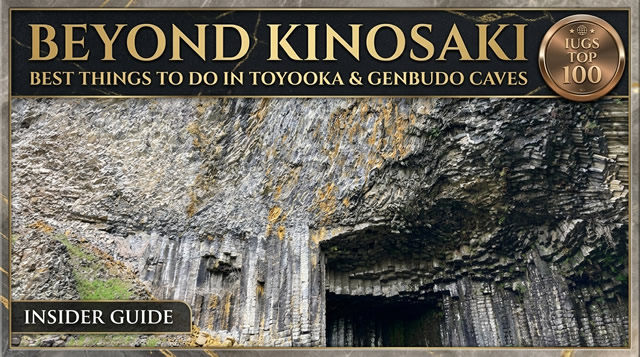
Beyond Kinosaki: Best Things to Do in Toyooka & Genbudo Caves (Geopark Japan Guide)
Are you looking for another mind-blowing experience just a stone’s throw from Kinosaki Onsen?
If so, you absolutely cannot miss Genbudo Caves. It’s one of only two sites in all of Japan—yes, only two!—to be honored in the prestigious “IUGS Top 100 Geological Heritage Sites.”
We’re talking about a breathtaking landscape forged by volcanic fury 1.6 million years ago. But let’s be honest: the official Geopark websites read like dry geology textbooks—boring! Plus, as an international traveler, you’re probably worried about the tricky local access or what to do on those legendary snowy days, right?
That’s where I come in. In this guide, I’m skipping the fluff and giving you the “Real Genbudo Experience” you won’t find in any official brochure. From the absolute best way to explore the caves to foolproof transport tips, the legendary “Oriental Storks,” and even the buzzing energy of the nearby “Samurai castle town”—I’m here to navigate you through the ultimate local route for a perfect day.
About the Credibility of This Article (A Message from Your Local Writer)
- Global Travel Media Contributor: Official author for the Genbudo Caves page on Atlas Obscura and the Kinosaki Onsen guide on Dave’s Travel Corner.
- Absolute Local Expert: Born and raised in Toyooka City. I lived here until university and still return every single holiday (New Year, Golden Week, and Obon) to stay fully up-to-date.
Hi! I’m Hiroshi Akiyama, a travel writer.
When you search for Kinosaki Onsen or Genbudo Caves, you’ll likely find a few official English guides. Those detailed articles on Atlas Obscura and Dave’s Travel Corner… the truth is, I wrote all of them (lol).
However, those top global media outlets have word counts and “polite rules,” which means there are many insider stories I simply couldn’t include.
My mother is from the neighboring town of Izushi, and I’ve been exploring this area for as many years as I’ve been alive. In fact, I’m heading back next month to check the latest local conditions.
That’s why this article is my secret “zero-constraint, ultimate local insider guide” shared only with my own readers. You can go ahead and close those boring “summary sites” or textbook-official pages now. Just follow my lead!
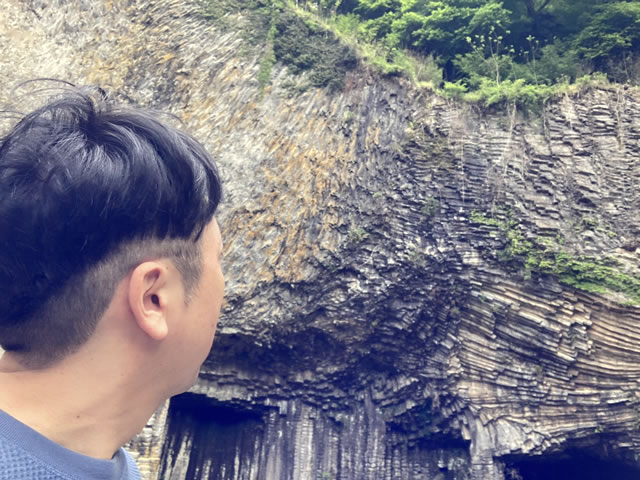
What is a UNESCO Global Geopark in Japan? Discover the Magic of the San’in Kaigan
- Geopark Japan: There are 10 UNESCO-certified geoparks in Japan… but that’s just the starting line.
- IUGS Top 100 Geological Heritage Sites: A list of the “First 100” launched by IUGS in 2022. Only two were selected from all of Japan.
- Hyogo Prefecture’s Exclusive Honor: Those two sites are the Nojima Fault on Awaji Island and Genbudo Caves right here in Toyooka!
Don’t waste time wondering which “Geopark Japan” is actually worth visiting.
In 2022, the International Union of Geological Sciences (IUGS) released a list of the 100 places you must see to understand Earth’s history—ranking them alongside icons like the Grand Canyon and Mount Everest.
In all of Japan, only two sites earned that incredible honor.
One is the Nojima Fault (Awaji Island), which tells the story of the earth’s raw power through earthquakes. The other? It’s Genbudo Caves in the San’in Kaigan Geopark!
Can you believe it? Outshining all the famous scenic spots across Japan, this cave in Hyogo—and in my own hometown!—was recognized by the world’s top scientists as a “Treasure of the Earth.”
Had enough of the dry textbook explanations yet? Come on, let me, your Expert Master, guide you into the absolute peak of Japan’s geological heritage!
Genbudo: Must-See Highlights of Genbudo Park
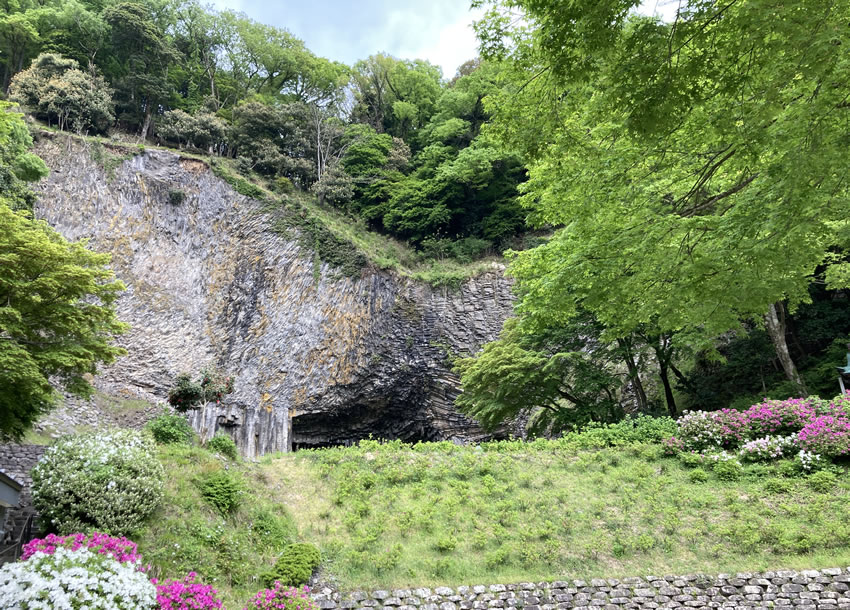
Alright, let’s get into the main event: Genbudo Caves.
This site is made up of five distinct caves (Genbu, Seiryu, Byakko, Suzaku, and Kita-Suzaku) located within Genbudo Park.
The absolute star of the show is the “Basalt Columns” (columnar jointing) that look like a giant, perfectly organized honeycomb. Can you believe this is actually the result of lava cooling and hardening 1.6 million years ago? It’s massive, natural sculpture art at its finest.
Honest Thoughts from a Local: Is the 500 Yen Fee Actually Worth It?
- Before August 2022: It was always free.
- Now: Admission is 500 yen.
- Honestly: At first, we locals laughed and said, “What? You’re charging for this now? How ridiculous! (lol)”
It’s true—this park only started charging 500 yen in August 2022. For us “natives” who grew up playing here for free, our honest reaction was, “Whoa, they’re really turning this into a business now!”
But honestly? Once you step inside, you’ll get it. Since they started charging, the paths have become much cleaner and the exhibits are way easier to follow. Most importantly, a “one-coin” (500 yen) contribution is a small price to pay to maintain a landscape that’s been selected by the world. I can guarantee that nobody leaves feeling like they wasted their 500 yen.
How to Walk the San’in Kaigan Geopark Trail (Advice from a Local)
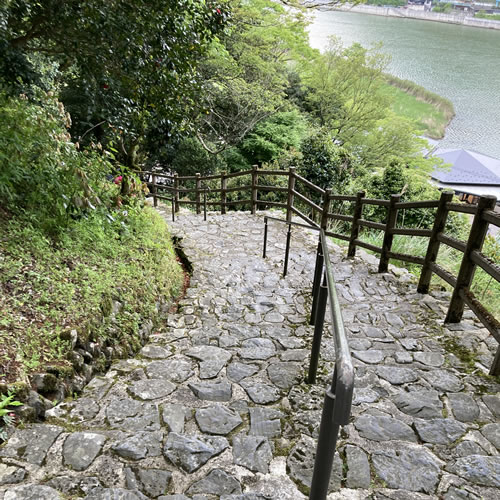
They call it the “San’in Kaigan Geopark Trail,” which sounds fancy, but in reality, it’s just a lot of climbing and descending stairs. Here is some expert advice:
- Sneakers are MANDATORY: Don’t even think about coming here in sandals. That’s just crazy.
- Stair Restrictions: Currently, some stairs might be closed off for “rockfall inspections.” Even if the official brochure says you can “see everything,” the reality on the ground might be different. Just consider it part of visiting a “living Earth” and enjoy the ride.
Genbudo Museum: Deciphering 1.6 Million Years (But is it necessary?)
Right next to the park is the Genbudo Museum. It’s filled with rare stones and fossils from around the world—a decent place to kill some time.
…However, if you want my Local Tip: instead of paying another 800 yen just to look at “mysterious rocks,” you’re better off spending that time and money relaxing on a park bench. To me, that’s a much more luxurious way to spend your afternoon (lol). Unless you’re a total “rock geek,” the scenery in the park alone will be more than enough to blow your mind!
Winter in Genbudo: Experiencing the San’in Kaigan Geopark Snow
The San’in Kaigan Geopark snow in winter is, quite frankly, out of this world. The contrast of pure white snow against the dark, jagged rocks is like a living Sumi-e (monochrome ink painting). It’s breathtaking.
But before you get too excited, stop and listen to my advice as someone who grew up here. If you underestimate this climate, you’re going to have a bad time.
Is it Safe to Visit During the Snow Season? (The Truth About Access and Climate)
- Summer: It consistently hits record-breaking highs in Japan. Honestly? It’s a sauna. You just eat ice cream and pray.
- Winter: Despite our latitude, we get dumping snow levels comparable to Hokkaido.
- The Reason: We are in a “Basin” (Bonchi) surrounded by mountains. Heat and snow—it all gets trapped right here!
If you’re thinking, “I’m used to driving on snowy roads, a rental car will be fine,” let me stop you right there.
Toyooka’s basin topography means when it snows, it piles up fast. Even as a local, I drive with extreme caution during winter. Unless you’re a professional rally driver, you should stick to taxis or public buses.
If you absolutely must drive yourself, you need more than just studless tires—you need the mindset of a specialist. Honestly, the winter cold here will chill you to the bone. But that silence, that stillness of Genbudo wrapped in white… it’s worth seeing, even if you’re shivering. Just do it the safe way and witness this “winter masterpiece” created by the Earth!
Best Things to Do Around Toyooka: The Local Secret Route
- Hyogo Park of the Oriental White Stork: A sacred site where you can meet the legendary bird that “brings babies.”
- Izushi: Known as the “Little Kyoto of Tajima,” and my mother’s beloved hometown.
- The “National Treasure” Movie Phenomenon: Why this quiet town is suddenly the center of world attention.
After witnessing the jaw-dropping geological wonders of Genbudo, why not dive deeper into the heart of Toyooka? Official guidebooks will give you the standard spots, but here, I’m giving you the “Real Deal”—the authentic charm of Toyooka that only a hardcore local like me knows.
Meet the Legendary Bird: Don’t Look at the Sky, Look at the Rice Fields! Pro “Stork-Watching”
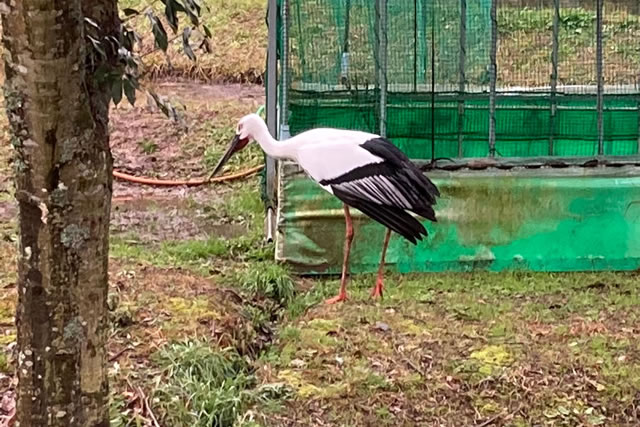
At the Hyogo Park of the Oriental White Stork, you’re guaranteed to see storks in captivity. But let’s be honest—that’s just “standard tourism.” Boring, right?
If you want a real thrill, challenge yourself to a “Stork-Watch” on your way to Genbudo and find a wild stork on your own. This is how the true experts play it.
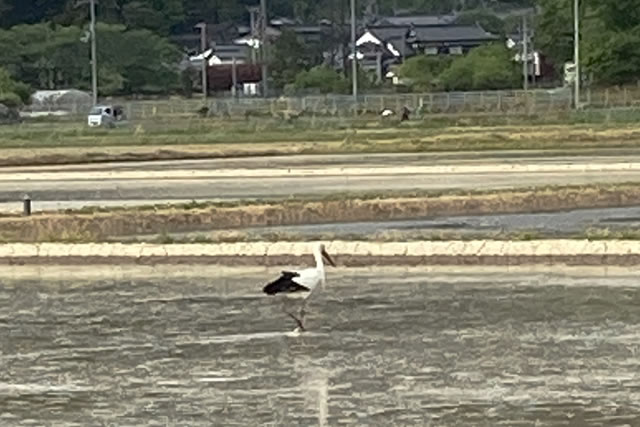
- Don’t look at the sky: Tourists always look up. But storks spend way more time standing in the fields than flying.
- Look for the “Out-of-place White”: Look for a bright white spot amidst the green and brown of the fields. That’s your stork.
- Know the territory: The east side of the Maruyama River (near the park) has the highest encounter rate. If you find one on the west side, you’ve witnessed a true miracle!
My father (a local master with 78 years of experience here) always says, “They’re there when they’re there, and they aren’t when they aren’t” (lol). But if you keep your eyes peeled on the rice fields along the river toward Genbudo, you might just find this “Legendary Bird” casually hunting for loaches right next to the road.
If you find one, you’re a “Wildlife Researcher”!
If you manage to snap a photo of a wild stork, don’t just post it on SNS and call it a day. Look for the colored rings on their legs. If you can see those colors, email your photo to the Stork Park. Your report becomes crucial data for protecting this endangered species. Now that is the ultimate travel souvenir.
Kinosaki Onsen “Konoyu”: A 1,400-Year-Old Bond
Why are we locals so obsessed with storks? Because 1,400 years ago, a local found a stork healing its wounded leg in a hot spring. That was the birth of Kinosaki Onsen (Konoyu). Storks aren’t just mascots for tourists; they are our “Treasured Neighbors” who have lived alongside us for over a millennium.
I’ve kept a raw record of when I actually encountered storks on my way to Genbudo. If you can read Japanese, check this out to feel the “local vibe” and see how differently we view these birds!
👉 Is seeing a stork lucky? A local’s guide to the “Real Rarity”
Izushi Castle Town and the “National Treasure” Movie Phenomenon
Next up, you absolutely have to visit Izushi, accessible by bus from Toyooka Station. This is my mother’s hometown and, for me, the quintessential Japanese countryside. The old castle town and the famous “Izushi Sara Soba” (buckwheat noodles served on small plates) are must-haves, but lately… things have gone absolutely crazy here.
Eirakukan: Why a 125-Year-Old Theater Became a “Holy Ground”
Have you heard of Eirakukan, the oldest playhouse in the Kinki region? It is currently the main filming location for the movie National Treasure (Kokuhou), which is causing a massive social phenomenon across Japan.
- Cultural Depth: A place where the “breath” of Kabuki, Geisha, and 100+ years of traditional performing arts is still alive.
- The Scent of a Star: Japan’s top actor, Ryo Yoshizawa, gave a soul-stirring performance right on this stage.
- Ultimate Travel Status: Saying “I went to Eirakukan in Izushi” is instant proof that you are a true “Japan Expert” who knows both modern trends and deep traditions.
To be honest, before the movie, this was just a quiet, charming building loved by locals. But now? Fans and culture-seekers from all over the world are flocking here, convinced that “the essence of Japanese beauty is concentrated here.”
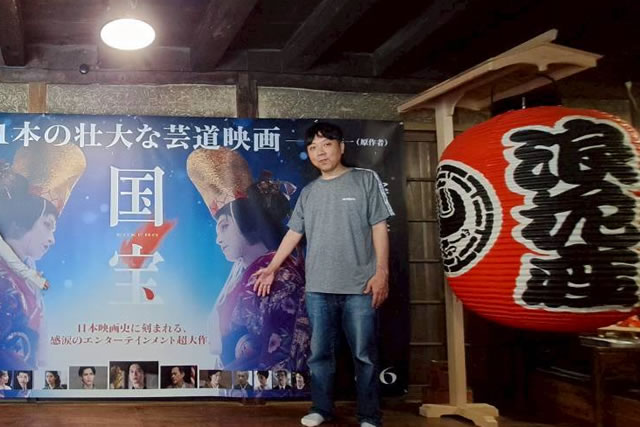
At the filming location for “National Treasure,” the Eirakukan Theater in Izushi…
I sat in the exact spot where Ryo Yoshizawa sat in the dressing room and struck the same pose. It was a priceless time feeling the history of this National Treasure-class building and experiencing a tiny bit of what the actors felt.
One of the best things about “Resort Baito” is being able to have amazing travel experiences like this! #NationalTreasure #RyoYoshizawa #Izushi #Eirakukan #ResortBaito #Travel pic.twitter.com/YS1pHLL6YR
— Hiroshi Akiyama (@akihanshin) August 16, 2025
This is my real-time X post from when I visited Eirakukan. Can you feel the heat of the place through these photos?
“At Eirakukan in Izushi, the filming site for ‘National Treasure’.”
“I found the dressing room spot where superstar Ryo Yoshizawa actually sat, and I struck the same pose. Perfect recreation, right? (lol)”
“Feeling the history of this National Treasure-class building and experiencing the actor’s perspective for just a moment… it was truly a priceless, once-in-a-lifetime experience.”
If you visit here and post those photos on SNS, just watch what happens. Your Japanese friends will be like, “Wait, you went to the National Treasure filming site?! That’s so cool! How sophisticated!” You’ll be looked at with pure envy.
Stepping on those old wooden floors, peeking into the “Naraku” (the underworld/trapdoor area) under the stage, and feeling the energy of entertainment that has continued since the Edo and Meiji eras… this isn’t just a tourist stop. It’s a “Privileged Experience” that touches the very core of Japanese pop culture and tradition.
Conclusion: Venture Beyond Kinosaki! The Essence of a World-Class Geopark and Toyooka’s Soul
“Going to Kinosaki Onsen, hopping between the seven public baths, eating crab, and going home…”
Sure, that’s a fantastic trip. But if you’ve read this far, you already know the truth: that’s barely scratching the surface of the true essence of this land.
- A 1.6-Million-Year Miracle: Did you witness the jaw-dropping beauty of Genbudo Caves—honored alongside Mt. Fuji as one of the world’s top geological treasures?
- The Rice Fields, Not the Sky: Did you experience the raw thrill of spotting a wild stork on your own during a “Stork-Watch”?
- Tradition Meets Excitement: Did you soak in the 125-year-old atmosphere of Izushi’s Eirakukan and the buzz surrounding the movie National Treasure?
Only after experiencing all of this do you transition from being a mere “tourist” to a true traveler who understands the rhythm of this land. Relaxing in an onsen is great for the body, but shaking your soul with Toyooka’s nature and history is a treasure that lasts a lifetime.
For the “Greedy” Travelers Who Want More!
“Hiroshi, tell me more!” …I can hear you already (lol).
Luckily, as a specialist of this area, I’ve authored official guides for several world-class travel media outlets. If you want to dive even deeper into the perfect Kinosaki itinerary or the mind-blowing science behind Genbudo, check out my articles below:
- Master the Perfect Kinosaki Itinerary:
👉 Kinosaki Onsen Itinerary: Guide to Japan’s Hidden Gem (Dave’s Travel Corner) - Dive Deep into the Mystery of Genbudo:
👉 Genbudo Park: The Birthplace of Magnetic Reversal Science (Atlas Obscura) - Explore Japan’s Oldest Hot Spring, Arima:
👉 Arima Onsen Day Trip: Exploring Japan’s Oldest Hot Spring Town (Amateur Traveler)
Now, throw away those dry, textbook-style guidebooks!
Take my lead and venture one step beyond Kinosaki to find the “Real Toyooka.” I can’t wait to see you on the ground! And hey, if you spot me when I’m back in town next month, come say hi! (lol)