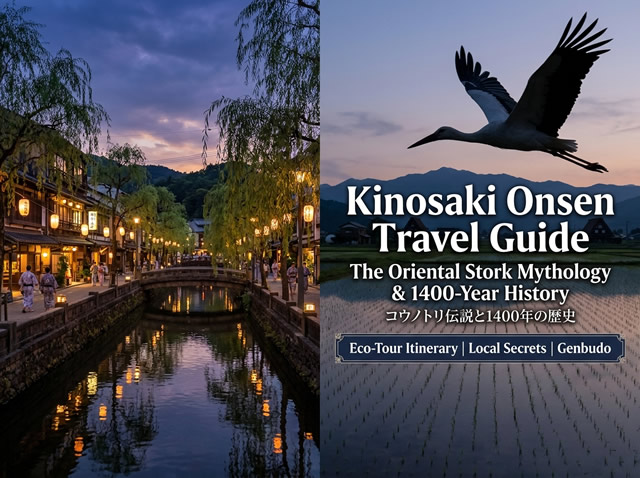
Welcome to our comprehensive Kinosaki Onsen Travel Guide. For many visitors, Kinosaki is simply a famous hot spring town. But as someone who grew up in the Toyooka and Kinosaki region, returning home every holiday, this land holds a deeper meaning. It is the living sanctuary of the Oriental Stork (Ciconia boyciana).
When international travelers research Japanese crane mythology or crane symbolism in Asian culture, they often confuse the two birds. However, the legendary bird that discovered Kinosaki’s healing waters 1,400 years ago was not a crane, but an Oriental White Stork.
Today, while tourists often stand still, looking up at the sky hoping for a spiritual encounter or good luck, locals simply say, “Oh, there’s one,” accepting them as a normal part of daily life. In this difference in perspective (temperature gap) lies the true secret to actually spotting them in the wild.
This page is not just about glorifying the bird or focusing solely on Japanese stork symbolism. Based on my real experiences as a local, I have compiled a practical guide to answer:
“What is the actual probability of seeing an Oriental Stork?”
“How and where do locals look to find them?”
Along with these practical tips, we will explore the 1,400-year history of Kinosaki Onsen’s Kono-yu (Stork Bath) and share my real-life encounters with these birds on the way to the famous Genbudo Caves. Through this guide, I will show you the authentic, unbroken connection between Toyooka and Kinosaki.
The 1,400-Year Bond Between Kinosaki Onsen’s “Kono-yu” and the Oriental Stork
Why are Oriental Storks so seamlessly integrated into the landscapes of Toyooka and Kinosaki?
It is not simply because this is a “tourist destination.”
It is because this land holds a deeply rooted history of coexisting with these birds since ancient times.
The “Healing Hot Spring” Discovered by an Injured Stork
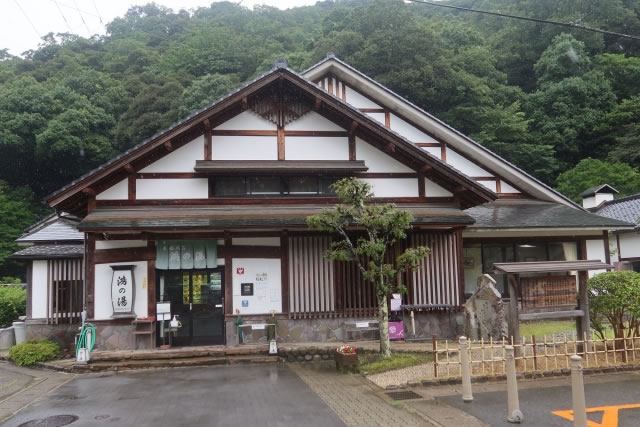
It is one of the oldest hot springs in Kinosaki, deeply connected to the legend of the Oriental Stork.
One of the public bathhouses (soto-yu) in Kinosaki Onsen is called “Kono-yu” (The Stork Bath).
The origin of its name dates back approximately 1,400 years to a legend where an injured Oriental Stork (Ciconia boyciana) was found healing its wounds in this very spot.
Eventually, a hot spring gushed forth from that location.
In other words, for Kinosaki Onsen, the stork is not just a symbol added as an afterthought; it is the very existence that sparked the beginning of the hot spring itself.
- Facility Name: Kono-yu (The Stork Bath)
- Location: 610 Yushima, Kinosaki-cho, Toyooka City, Hyogo Prefecture
- Business Hours: 7:00 AM – 11:00 PM
- Closed: Tuesdays (Open if it is a national holiday)
- Details: Legend of Kinosaki Onsen | Official Tourism Association
“Yume Hanabi” (Dream Fireworks) Illuminating the Sky Where Storks Soar
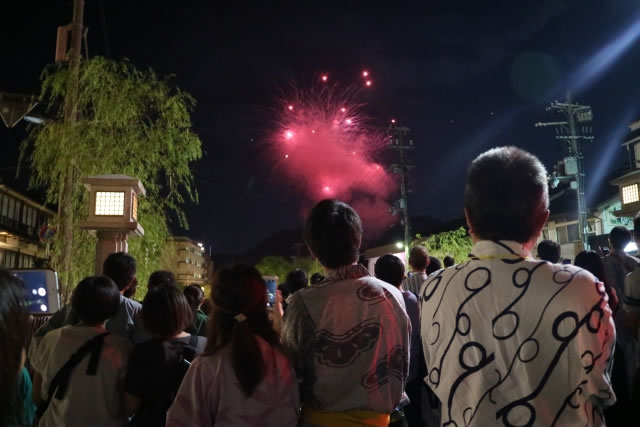
This is the summer tradition of Kinosaki Onsen, “Kinosaki Onsen Summer Story: Yume Hanabi (Dream Fireworks)”.
Even a casual glance at the fireworks takes on a deeper meaning when you know the background of this land.
It is a night sky where you can imagine the layers of time, knowing that the Oriental Storks must have soared through this same sky.
▶ Learn more about Kinosaki Onsen Summer Festival in Hyogo * Travel Japan (JNTO)
Is Spotting an Oriental Stork Good Luck? Locals Reveal the “True Rarity”
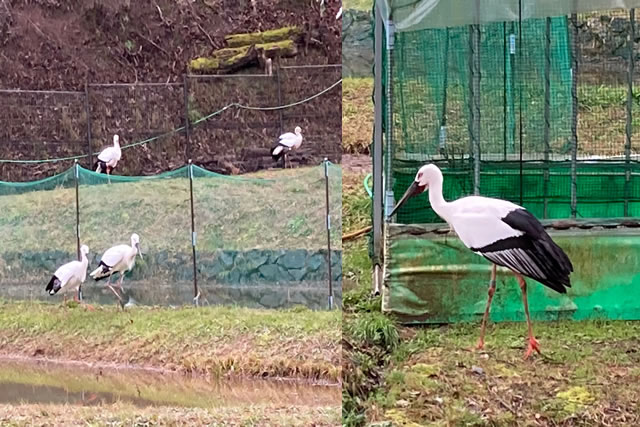
Unlike the individuals living naturally in the wild, you can observe their appearance and characteristics up close here.
“Seeing a stork brings good luck,” or “They bring babies.”
You often hear such spiritual images and Japanese stork symbolism.
Certainly, encountering a wild Oriental Stork is a special experience.
However, the “reality” I feel every time I return to my hometown of Toyooka is a bit different.
While tourists try hard to find them by looking up at the sky, locals just pass by without paying much attention, thinking, “Oh, there’s another one.”
In this temperature gap in perception lies the very hint that greatly influences your “probability of encountering an Oriental Stork.”
| Perspective | Tourists | Locals |
|---|---|---|
| Where to look | Look up at the sky | Look at rice paddies & wetlands |
| Feeling | A miracle if spotted | “They are here today.” |
| Encounter Rate | Feels low | Feels high |
Lucky if You Spot One! Could Your Photos Contribute to “Research”?
If you are lucky enough to encounter an Oriental Stork and take a picture with your smartphone, just uploading it to social media might be a bit of a waste.
Actually, the Hyogo Park of the Oriental White Stork continuously collects sighting information in the wild.
Particularly important are photos where the colors of the “leg bands (rings)” can be identified.
This is highly valuable data used to identify individual birds.
- Date and time of shooting (approximate is OK)
- Location (e.g., near [Place Name], along the Maruyama River)
- Number of birds (single/multiple)
- A photo where the colors of the leg bands (rings) are visible
Please share your lucky experience of “seeing an Oriental Stork” as a contribution to research and conservation activities.
- Facility Name: Hyogo Park of the Oriental White Stork (Sighting Information Desk)
- Address: 128 Shounji, Toyooka City, Hyogo 668-0814
- Email: mokugeki@stork.u-hyogo.ac.jp
- Official Details: Providing Information on Oriental Stork Sightings (Japanese)
The Gap Between Spiritual Meanings and “Everyday Life”
We often hear that “the stork is a symbol of good luck” or that it has spiritual meanings, but the way it is perceived locally in Toyooka is a bit different.
Today, the feeling is not “it’s a miracle if seen,” but rather “it’s proof that nature is properly circulating.”
The Oriental Stork is no longer just a legend; it is a “neighbor” that has returned to the landscape of our daily lives.
[Verification] Asking a 78-Year Toyooka Resident the “Probability of Seeing an Oriental Stork”
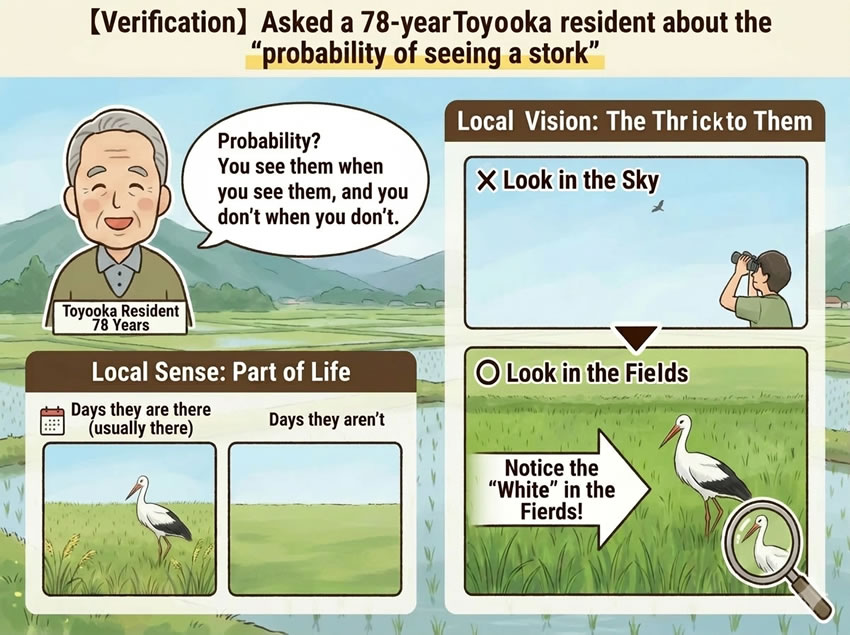
On the internet, vague expressions like “you can see them if you’re lucky” or “they are quite rare” stand out, but they don’t give you a real sense of it.
So this time, I asked someone who has lived in Toyooka for about 78 years and has observed the local landscape and culture for a long time about the “actual, raw feeling” of encountering an Oriental Stork.
Testimony from a 78-Year Resident and Local Craftsman
When I frankly asked, “Can even tourists see them?”, the answer was surprisingly casual.
“Probability? Well… when you can see them, you see them. When you can’t, you can’t.”
These words represent the local realization that encountering a stork is not something that can be calculated like ‘X% probability.’
Rather than drawing a special stroke of luck, “On days they are here, they are just here; on days they aren’t, they aren’t.”
Locals accept them as a part of everyday life with this kind of relaxed distance.
The Local Eye: “Look at the Rice Paddies, Not the Sky”
When asked how to find them, the answer revealed a perspective unique to someone who has lived here for many years.
“Everyone looks up at the sky, but they are in the rice paddies more often than they are flying. If you see a ‘white’ standing in the paddy that stands out from the surroundings, that’s a stork.”
Instead of trying to search the distant sky, it is about whether you can notice the “out-of-place white” blended into the landscape of the rice paddies.
This very sense is the natural “way of finding them” acquired by locals.
Sense of Location: “Not All Rice Paddies Are the Same”
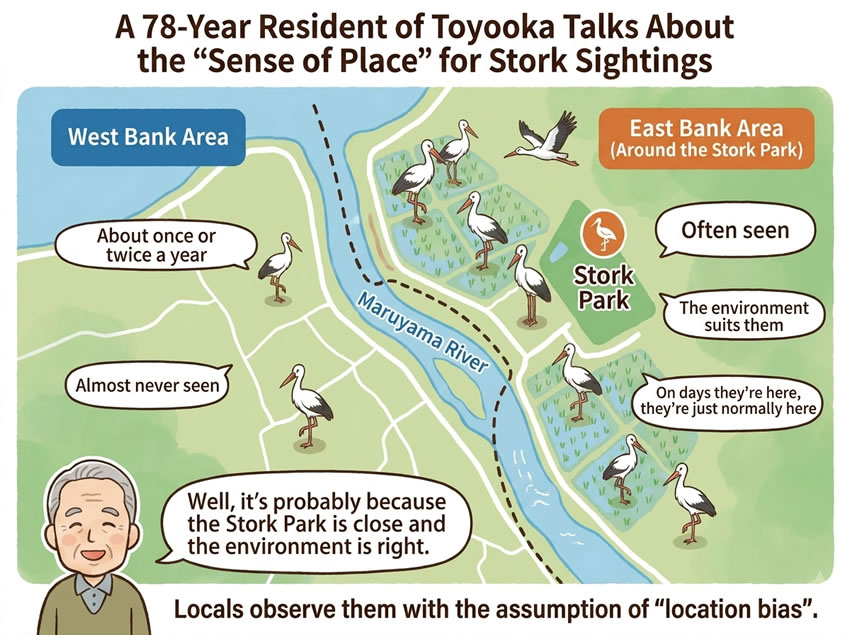
It reflects the true local feeling: they are seen almost daily on the east bank (around the Stork Park) across the Maruyama River, while they are only seen once or twice a year on the west bank.
He seemed to have a very clear sense regarding “location.”
“I often see them on the east side where the Stork Park is (the east bank of the Maruyama River).”
“On the west side across the river, I’ve only seen them maybe once or twice a year.”
When asked why,
“Well, because the park is close by and the environment is right for them, I suppose.”
A very natural answer came back. You can’t see them with the same probability everywhere; locals look for them with the premise that there is a “regional bias.”
Interviewee / Cooperation: Michihiro Akiyama
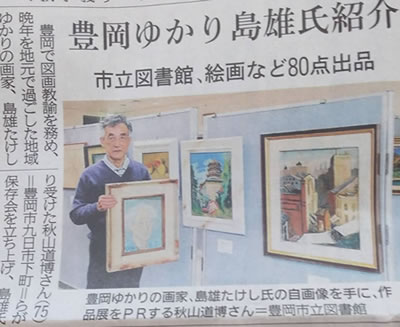
It is a moment where the activities accumulated in the community were recorded in the newspaper.
- Newspaper Article (Reference): Kobe Shimbun Article (Japanese)
- Takeshi Shimao (Toyooka Painter) Preservation Society: Official Website (Japanese)
[Proof] Actual Photos of a “Stork in the Rice Paddy” Taken on Site
From here on, it is not just desk theory, but first-hand information I actually witnessed with my own eyes.
If you are thinking, “Can you really see them that easily?”, please read about this experience.
On the Way to Genbudo, a Globally Recognized Geo-Spot
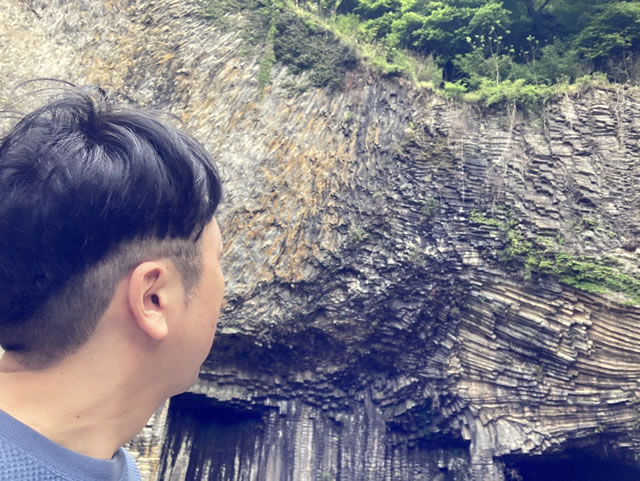
Afterward, arriving at the site and checking the topography and surrounding natural environment of Genbudo with my own eyes.
The nationally designated Natural Monument, Genbudo (Genbudo Caves), is also selected as one of the “IUGS Top 100 Geological Heritage Sites” in the world.
In Japan, only this Genbudo and the Nojima Fault (Awaji City) have been chosen for this prestigious list.
Wanting to share this amazing place more with the world, we created the Genbudo English page on this site and visited the location to prepare an article contribution for Atlas Obscura, a major international travel media outlet.
The area along the Maruyama River leading to Genbudo is a rich natural environment with spreading wetlands and rice paddies.
Consequently, this location met all the ideal conditions as a feeding ground for the Oriental Stork.
*Primary Information Note:
This surrounding area was not a “special place to go searching for them,” but an environment where they normally exist as an extension of daily life routes.
A Completely Everyday Encounter Starting with “There’s One.”
While heading to Genbudo for the field report, my mother was also riding in the car.
Without particularly looking for anything, in the natural flow of conversation:
Mom: “…Oh, there’s a stork.”
My uncle “Kunichan” in the passenger seat also muttered, keeping his eyes on the road.
Kunichan: “Well, I guess it’s a day they’re here.”
It was said literally like talking to oneself.
There was absolutely no excitement of “I found one!”, but rather a very normal tone as if to say, “They’re always around.”
I unintentionally let out an “Eh!?” and, since it was a country road, hurriedly pulled the car over to the shoulder next to the paddy.
[Photographic Proof] Unedited | The Real Moment of Encounter
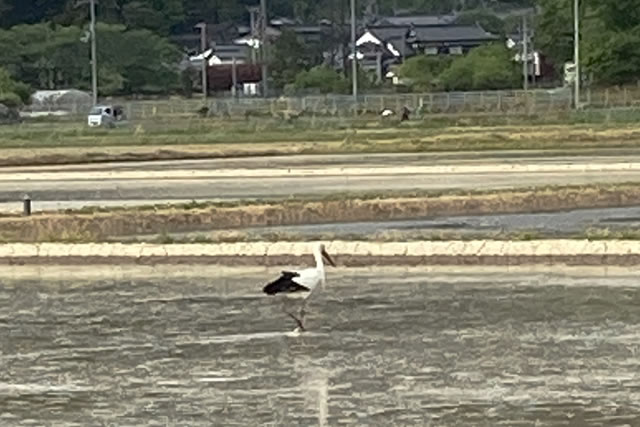
The image quality is a bit rough, but this is a record of the moment it was “really there.”
It blended into the landscape so much that it was at a distance you would completely miss if you weren’t paying attention.
No telephoto lens, just this distance snapped casually with a smartphone.
This experience felt less like “searching and finding” and more like it suddenly appeared within the natural flow of daily life.
The location was a rice paddy on the way to Genbudo.
The timing was the latter half of the Golden Week holidays (early May), a time when living creatures gather in the flooded paddies.
Being relatively close to the Stork Park, this individual was likely searching for loaches in the soil of the rice paddy.
Supplement | Is There a “Best Season” to See the Oriental Stork? The Local Perspective
“When is the best time to see the Oriental Storks?” is a question we often hear from tourists.
However, from the local perspective here in Toyooka, there is no definitive answer like “you can only see them during this specific season.”
This is because, in the current Toyooka area, the Oriental Stork is a wild bird that lives here year-round.
Rather than completely disappearing depending on the season, it is closer to the local understanding that “their whereabouts change with the seasons.”
Generally speaking, from spring to early summer when the rice paddies are flooded with water, and in autumn after the rice harvest, it is said to be a time when they are easy to spot in the paddies due to the abundance of creatures they feed on.
However, this is just a rule of thumb.
In fact, a striking comment from our local interview was, “I don’t really remember seeing storks in the winter.”
Rather than disappearing in the winter, they have simply moved to places that are out of plain sight—that is the natural distance locals feel.
Ultimately, what is more important than the season is the time of day, the location, and how you look at the landscape.
By understanding what the locals are looking at, your chances of an encounter will naturally increase.
Sample Itinerary & Local Cuisine: The Ultimate Kinosaki Eco-Tour
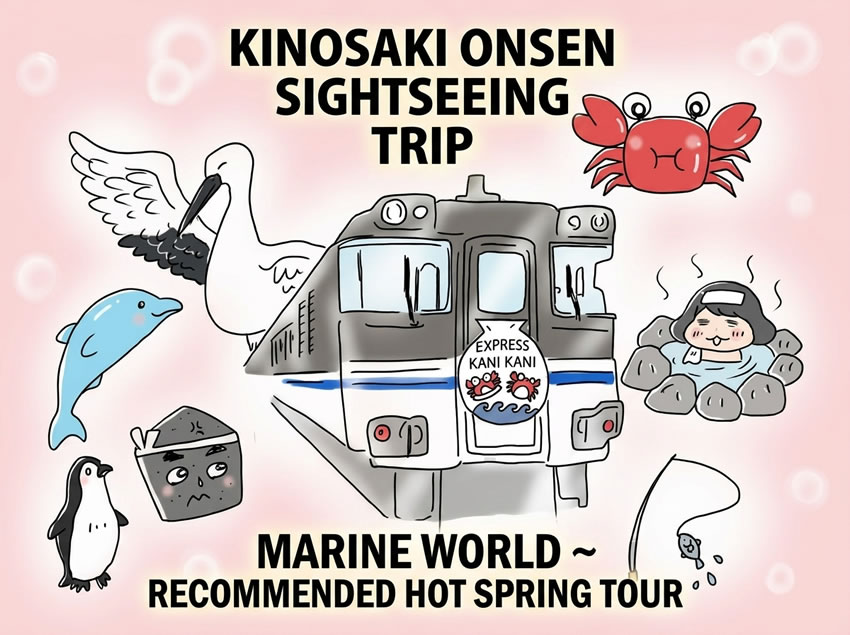
Please also visit the Kaori Akamatsu Official Website and our Free Resort Illustrations.
If you are planning to visit the areas introduced above, here is a highly recommended 2-day/1-night model itinerary. All photos below are from our actual on-site research!
Day 1: Nature, Seafood, and Hot Springs
10:30 AM – Arrive at Kinosaki Onsen Station
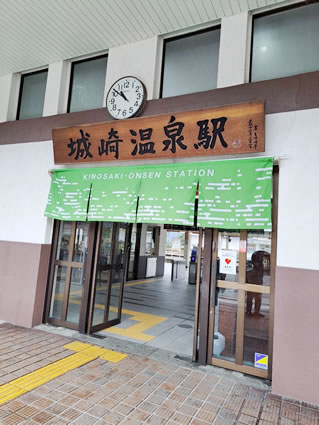
From Osaka, it takes about 2 hours and 40 minutes by limited express. We stored our large luggage in the coin lockers at the station to travel light.
11:30 AM – Kinosaki Marine World & Seafood Lunch

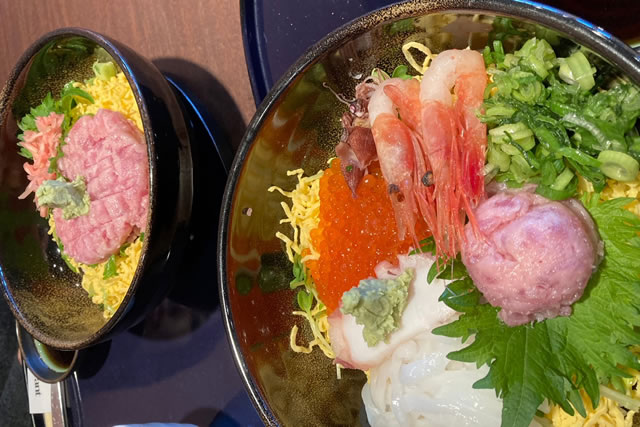
※↑ We enjoyed incredibly fresh tuna and seafood bowls!
Enjoy the interactive aquarium. You can even try fishing for horse mackerel and have it tempura-fried right on the spot!
2:30 PM – Check-in at Ryokan & Sotoyu Meguri (Bath Hopping)
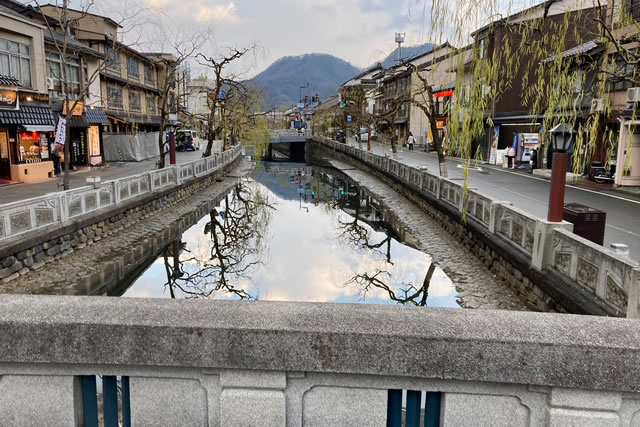

Change into a yukata and stroll the willow-lined streets in traditional wooden clogs. We visited Goshono-yu, famous for its spacious outdoor garden bath. And to truly experience the 1,400-year legend, be sure to drop by Kono-yu (The Stork Bath) as well!
6:00 PM – Local Cuisine (Dinner at the Ryokan)
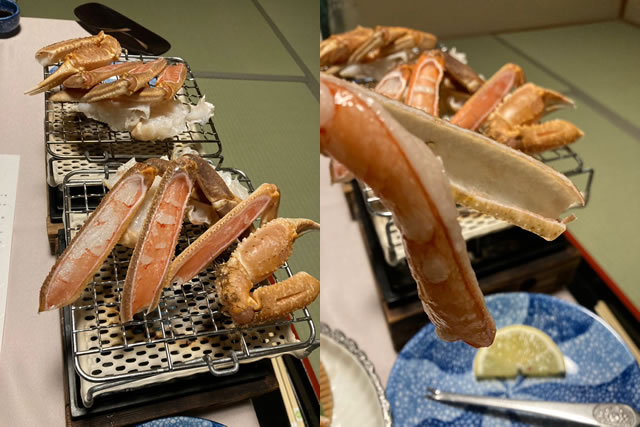
※↑ Fresh crab sashimi and grilled crab.

※↑ Crab hot pot (kani-suki) and seared Tajima beef.
Kinosaki’s culinary stars are the luxurious winter Matsuba Crab (Snow Crab) and premium Tajima Beef (the root stock of Kobe Beef). We had an amazing feast—it was a real kuidaore (stuff yourself) experience!
Day 2: Literature, Earth’s History, and the Oriental Stork
10:00 AM – Kinosaki Bungeikan (Literary Museum)

Learn why famous authors like Naoya Shiga fell in love with this town. It is located just a 5-minute walk from the station.
11:00 AM – Bath Hopping & Lunch
Enjoy a few more public baths and a relaxing lunch before leaving the hot spring town.
1:00 PM – Depart from Kinosaki Onsen
Leave Kinosaki Onsen with unforgettable memories and head south towards Toyooka.
2:00 PM – Genbudo Park (Genbudo Caves)

Witness the awe-inspiring columnar basalt formations created by magma activity 1.6 million years ago. This is a globally recognized IUGS Top 100 Geological Heritage Site. ▶ Read our full Genbudo Guide here
3:00 PM – Hyogo Park of the Oriental White Stork
The sacred ground for learning about the protection and breeding of the Oriental Stork (Ciconia boyciana). If you’re lucky, you might encounter wild storks in the surrounding rice paddies, just as we did!
4:30 PM – Return to Kansai Cities via Toyooka Station
Catch your train from Toyooka Station and head back to Osaka or Kyoto.
Conclusion | Don’t Look at the Sky, Look at the Rice Paddies
Whether or not you can meet an Oriental Stork is not a game of luck.
Borrowing the sense of those who have lived here locally for a long time, the answer is very simple:
“Don’t search the sky. Look at the rice paddies.”
It is about whether you can notice the white figure that suddenly stands out in the landscape.
It is not about having special knowledge or being born a naturally lucky person; rather, it is closer to looking at the scenery of the land just a little more carefully.
In Toyooka and Kinosaki, the Oriental Stork is not so much a “miraculous being,” but rather it quietly exists there as proof of a healthy, circulating ecosystem.
When you visit the area, please try turning your eyes not only to the main tourist spots but also to the rice paddies and the scenery along the river for just a moment.
If you happen to notice that white silhouette, it might just be proof that you have tuned in, even if just a little, to the rhythm of this land.